A good nonstick frying pan is one of the highest-use tools in any kitchen, and one of the most misunderstood — the differences between a pan you'll replace in a year and one that lasts come down to coating, construction, and how you treat it. This review-backed guide explains what to look for in coating type, size, and care, then lists our picks from products reviewed on Juicer.deals.
Coating: ceramic vs traditional (PTFE)
Nonstick pans use one of two coatings. Traditional PTFE (the classic slick coating) releases food superbly but degrades if overheated. Ceramic coatings are marketed as PTFE- and PFOA-free, appealing to cooks who want to avoid that chemistry; they release food well and handle heat, though the surface can lose some slickness over time. Neither is universally "better" — choose ceramic if avoiding PTFE/PFOA matters to you, traditional if maximum long-term release is the priority. Either way, a pan that names its coating and states it is PFOA-free is the baseline to look for.
Size: buy for the job, own two
Pan size decides what you can cook well. A 9–10 inch pan is ideal for eggs, one or two portions, and quick jobs; a 12 inch pan is what you need for family meals and stir-fries, because crowding food makes it steam instead of sear. Most kitchens are best served by owning both a small everyday pan and one larger one, rather than compromising on a single mid-size. If you're starting from nothing, a coordinated set is cheaper per piece than buying individually.
Construction: handle, base, and oven-safety
Look past the coating to the build. A flat, heavy base heats evenly and sits flat on the burner (essential on induction and glass hobs); a thin base warps and creates hot spots. A handle that stays cool and is securely riveted or moulded lasts longer than a loose screwed one. If you finish dishes in the oven, check the oven-safe temperature — many nonstick pans top out around 400°F, and a matching lid is a genuine convenience for anything you simmer or steam.
Care: how you use it decides how long it lasts
Nonstick pans fail early almost entirely from misuse, and the rules are simple. Never use metal utensils — wood or silicone only, so you don't scratch the coating. Cook on low to medium heat; nonstick coatings are not made for high-heat searing and break down when overheated (this is the number-one killer of nonstick pans). Avoid aerosol cooking sprays, which leave a residue that builds up, and hand-wash even "dishwasher-safe" pans to extend their life. Treated this way, a modest pan lasts years; abused, an expensive one fails in months.
Best nonstick frying pans: our picks
Drawn from products reviewed on Juicer.deals, covering an egg pan, an everyday size, a pan with a lid, a large sauté, a starter set, and a wok. Prices change, so each links to its full review.
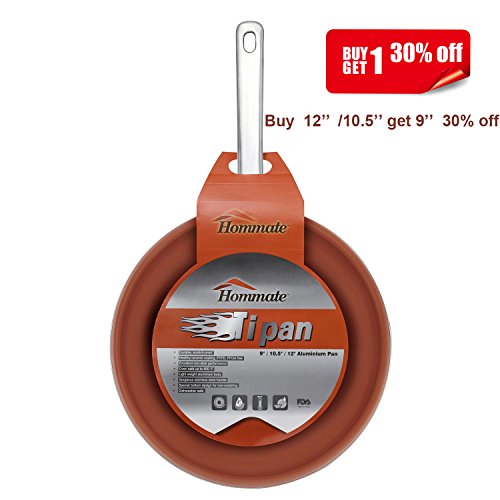
1. 9-Inch Ceramic Nonstick Fry Pan, Titanium, PTFE/PFOA-Free (Best for eggs & small jobs)
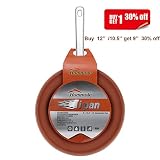
A 9-inch ceramic-coated pan built for eggs, omelets, and single portions, oven-safe to 400°F and free of PTFE and PFOA. The ceramic surface releases food cleanly without the chemistry some cooks want to avoid, and the small size heats fast for quick jobs. The pick for a dedicated egg pan.
Read the full review and check the current price →
2. 10.5-Inch Ceramic Nonstick Frying Pan, Titanium, Oven-Safe (Best all-round size)
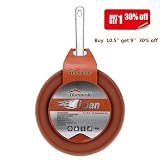
The 10.5-inch size is the everyday workhorse — big enough for a couple of portions, still easy to handle. Ceramic titanium coating, PTFE/PFOA-free, and oven-safe, so it moves from stovetop to oven. If you buy one pan, this is the size to buy.
Read the full review and check the current price →
3. Copper Stone-Coating Nonstick Frying Pan, 20cm, with Lid (Best with lid)

A stone-coated pan with a bakelite handle that includes a matching lid — a genuine convenience for anything you simmer or steam-finish, from fish to a covered fry. The included lid is the practical differentiator; buying pan and lid separately usually costs more.
Read the full review and check the current price →
4. 12-Inch Ceramic Nonstick Sauté & Frying Pan, Oven-Safe (Best large / sauté)
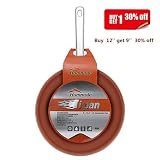
At 12 inches this is the pan for family portions, stir-fries, and anything that needs room to spread out without crowding. Ceramic nonstick, PTFE/PFOA-free, oven- and dishwasher-safe. Crowding is what makes food steam instead of sear, so the extra surface earns its space for larger cooking.
Read the full review and check the current price →
5. TAFOND 7-Piece Aluminum Nonstick Cookware Set with Lids (Best starter set)
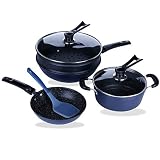
A seven-piece set — pots, pans, glass lids, plus a steamer insert and silicone spatula — for kitchens starting from scratch. Buying a coordinated set is cheaper per piece than assembling one, and the included lids and tools cover most everyday cooking immediately. The value pick for a first kitchen.
Read the full review and check the current price →
6. 12.5-Inch Ceramic Nonstick Wok with Lid & Steam Rack (Best for stir-fry)
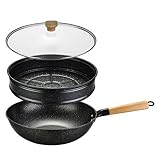
A flat-bottomed ceramic wok with a lid and steam rack, induction-compatible, for stir-fries, big sauces, and steaming. The high sloped sides toss food in a way a flat pan can't, and the flat bottom means it works on any modern hob. A versatile second pan once you have your everyday skillet.
Read the full review and check the current price →
Choosing in one line
Eggs and small jobs: a 9–10 inch pan. Family meals: a 12 inch. Avoiding PTFE/PFOA: ceramic. Starting a kitchen: a set. Then protect whichever you buy — silicone or wood utensils, low-to-medium heat, hand-wash — and it will outlast pans that cost twice as much.
Related buying guides: All buying guides